 Jamil Mahmud
Getting 10+ HTML5 games past App Store Guideline 4.7

| Product | My role | Stack | Outcome |
|---|---|---|---|
| Jeeto.Online, Riseup Labs | Product Manager | Flutter · HTML5 games · AWS S3 | iOS update approved |
Every product manager who ships on iOS eventually gets The Email from App Review. Ours arrived on what should have been a routine version update for Jeeto.Online, and it cited a guideline most of the team had never read closely: Guideline 4.7: HTML5 Games, Bots, etc. This is the story of why it happened, what we changed in the app, and the one step that actually got us approved, which turned out not to be a code change at all.
What Jeeto.Online is (and isn’t)
Jeeto.Online is a skill-gaming platform Riseup Labs built for players in Bangladesh, launched in January 2023. The app itself is written in Flutter, but the games inside it are HTML5: more than ten hyper-casual titles such as Go Ninja!!, Color Jump, Shape Match and Slidey Cube. Players compete on leaderboards in seasonal events and the best scores win prizes.
Two things matter for this story. First, every game is skill-based: there is nothing luck-based in the catalogue. Second, Jeeto.Online is not real-money gaming. Nobody bets money on an outcome; players practise for free and compete on score. The app sits in the Entertainment and Games category, and Google Play rates it for everyone aged 3 and up.
Why we loaded games from S3
A games platform lives on fresh content. The catalogue rotates, events need a new featured game, and individual games get tuned. If every one of those changes required a new app build and two store reviews, we would have shipped far less often.
So we kept the games outside the app. Each game was zipped and stored in its own folder on Amazon S3. When a player opened a game, the app fetched the bundle and ran it inside a webview. New game, new bundle, no release needed. From a product point of view it was a clean setup: the Flutter shell stayed stable while the catalogue stayed fresh.
The rejection
Then an update came back rejected.

The message said the app offered real money gaming HTML5-based games that are not embedded in your binary, and asked us to remove all non-embedded real-money HTML5 games, remove any links sending users to such games on the web, and make sure any other HTML5 games weren’t offered in a store or store-like interface.
Reading it as a PM, two words jumped out: real money and embedded. The first was a misreading of our product: prizes are awarded for skill, not bought with stakes. The second was entirely accurate. Our games were not in the binary. They arrived from a server at runtime, and from a reviewer’s seat a catalogue of downloadable games with prizes attached looks a lot like a store inside the app.
What Guideline 4.7 was really asking
Apple’s rule exists because software that isn’t in the binary is software Apple never reviewed. If an app can pull in new games from a server, it can also change what users get after approval. The guideline allows HTML5 mini games, but it makes the developer responsible for all of that outside software and is strict about how it is presented.
Apple has since renamed the section Mini apps, mini games, streaming games, chatbots, plug-ins, and game emulators and expanded it with sub-rules on privacy, content reporting and age limits. The principle is the same one we hit in 2023: if Apple can’t see it in the build, you have to prove it’s safe.
We decided the cleanest proof was to make the question go away.
Moving the games inside the binary
The engineering team and I agreed on a plan that kept the player experience identical while changing where every game came from:
- Bundle everything. All HTML, JavaScript, CSS and asset files for every game moved into the Flutter project itself.
- Split by platform. Game assets were organised into separate Android and iOS subfolders.
- Use Flutter flavors. Flavors handled the platform-specific configuration, so each store build carried only what it needed.
- Run games with
flutter_inappwebview. The package executes the bundled HTML and JavaScript inside the app. - Serve locally. At runtime the app starts a small virtual localhost server on a dedicated port just before a game loads, serves the bundled files to the webview, and shuts the server down when the game ends to free resources.
To the player, nothing changed: tap a game, play a game. To a reviewer, everything changed: every line of game code now shipped inside the binary they were reviewing.
The trade-off was real. Adding or updating a game now needs an app release, the flexibility we had built S3 for in the first place. We accepted it, because a fast release cycle is worth nothing if the release can’t get onto the store.
Rejected again, and the step that worked
We resubmitted with the games embedded. It was rejected again.
This is the moment teams tend to start rewriting more code. We didn’t. The build now did exactly what the guideline asked, so the problem was that the reviewer couldn’t see that. We replied to App Review in App Store Connect, explained precisely what had changed and why the app now complied, and asked for the submission to be rechecked.
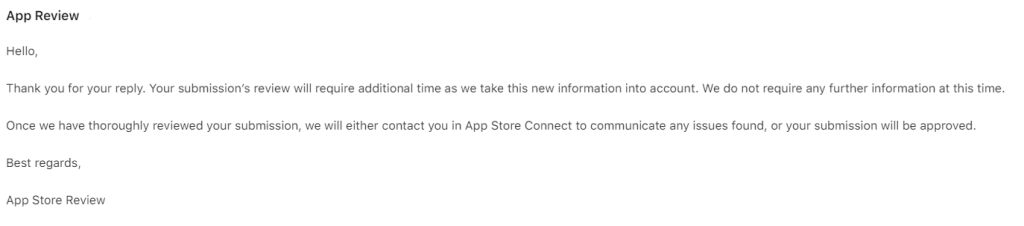
App Review answered that the submission needed additional time while they took the new information into account. An additional reviewer looked at the build, and it was approved.
What I’d tell any team shipping HTML5 games on iOS
- Reviewers judge where content comes from, not only what it is. Remote-loaded games read as an unreviewed store, however harmless they are.
- Say what you aren’t. Skill-based and not real money were true about Jeeto.Online, but nothing in the submission said so up front. Put it in the review notes before you’re asked.
- Price the flexibility. Remote content made shipping games fast; it also made the app harder to approve. Decide which matters more before a reviewer decides for you.
- A rejection is a conversation. A calm, specific reply about what you changed can do more than another round of code.
- Write it down. I wrote this up for the Riseup Labs blog so the next team to hit Guideline 4.7 would have a map. This post is that map, updated.
Originally written up on the Riseup Labs blog, October 2023. Guideline wording from Apple’s App Review Guidelines. Images © Riseup Labs.