Dokan
Multivendor marketplace platform for WooCommerce, used by 40k+ merchants in 52+ countries.
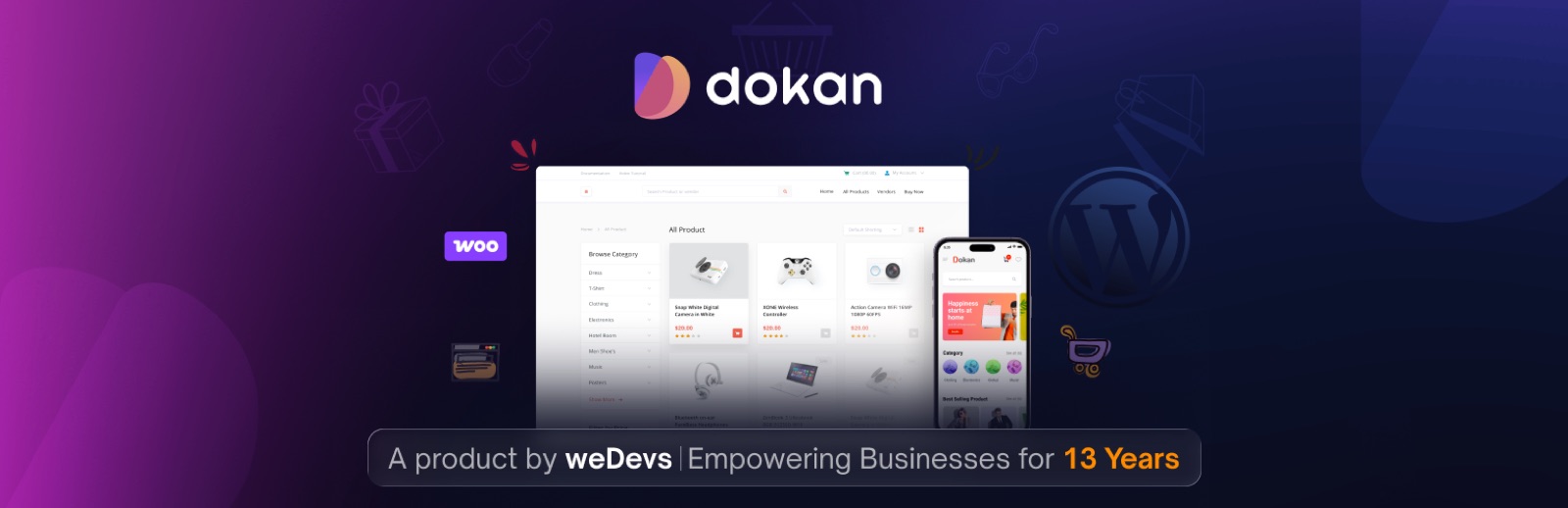 The Dokan Lite banner on WordPress.org. Source: WordPress.org
What it is
Dokan turns a WooCommerce store into a multivendor marketplace. One owner runs the site. Many independent vendors sell under one roof, each with their own storefront, product catalogue and dashboard. The owner earns a commission on every sale.
It serves people who want to build their own Amazon, Etsy or local food marketplace without writing code: agencies building for clients, founders testing a niche marketplace, and established retailers opening their shop to other sellers. The free plugin, Dokan Lite, lives on WordPress.org. Dokan Pro adds the paid modules: vendor subscriptions, auctions, bookings, shipping rules, vendor support, extra payment gateways and more. Merchants in 52+ countries run on it.
The core problem it solves is simple to state. WooCommerce is built for one seller. A marketplace needs vendor onboarding and verification, split payments, commissions, withdrawals, per-vendor shipping, per-vendor reporting and a way for vendors to manage their own orders. Building that from scratch is months of work. Dokan adds all of it on top of a store the owner already knows, and keeps it working as WooCommerce and WordPress change underneath.
There are two sides to every Dokan marketplace, and both have to work. The admin needs control: who can sell, what they pay, how money moves. The vendor needs a dashboard that feels like their own shop: products, orders, payouts and sales data in one place. Most of my time went into making both sides faster and clearer for stores that already earn money on it.
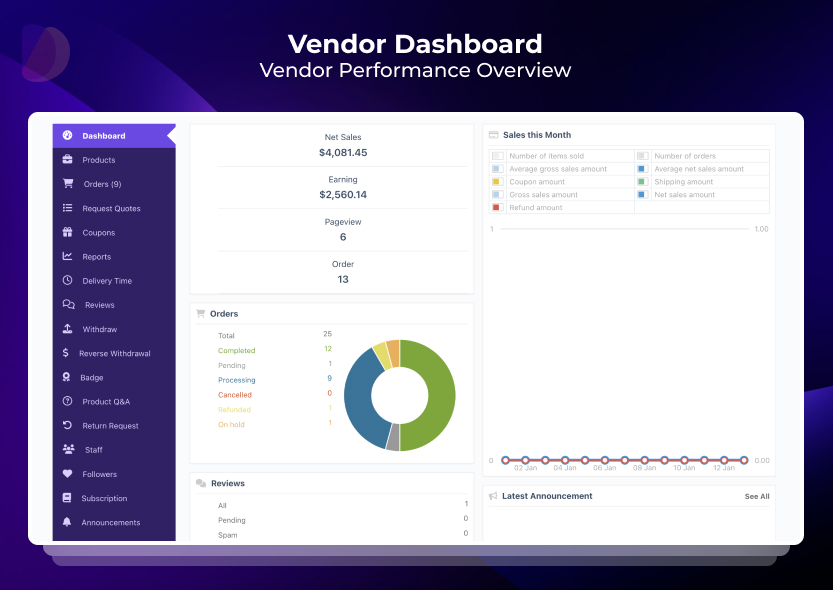 The vendor dashboard before the React rebuild: sales, orders, reviews and announcements in one view. Source: WordPress.org, Dokan Lite screenshots
Industry
Marketplaces are one of the main ways small businesses get online, and WooCommerce is one of the most used eCommerce platforms on WordPress. Inside that ecosystem the multivendor plugin category is crowded. WCFM Marketplace, WC Vendors and MultiVendorX all compete with Dokan for the same marketplace owners, and hosted SaaS marketplace builders compete from outside WordPress.
Buyers compare on a short list: how good the vendor experience is, which payment gateways are supported, how flexible commissions are, and how fast the product keeps up with WooCommerce itself. Switching costs are high once a marketplace has vendors and order history, so trust and stability matter as much as features. In 2025 two new fronts opened up across the category: generative AI for sellers, and modern, app-like dashboards.
What happened
I joined weDevs in October 2024 as Product Manager, owning strategy and roadmaps for Dokan and the wider Dokan plugin portfolio. The product was mature, with a large free user base, a long tail of Pro modules and an interface that had grown over many years. The work through 2025 was about modernising it without breaking marketplaces that run real businesses.
- Analytics and commissions (late 2024). Vendor reporting moved onto WooCommerce Analytics (Lite 3.13.0, November 2024), so vendors and admins read the same numbers from the same engine. The commission system was overhauled to support fixed and category-based commissions, alongside a product rebrand (3.14.0, December 2024). Printful print-on-demand arrived in Pro the same month.
- Dokan 4.0 with generative AI (May 2025). Vendors could generate product titles and short and long descriptions with AI, with the admin choosing OpenAI or Gemini as the provider. Nine vendor dashboard pages moved to React: withdraw, shipping, store SEO, staff, announcements, coupons, returns, product subscriptions and vendor subscriptions. The release also brought a new Tailwind component set, a setup guide for admins, WooCommerce Brands in the vendor panel and manual order creation for vendors in Pro. We positioned it as the first AI powered multivendor marketplace solution.
 Launch artwork for Dokan 4.0, May 2025. Source: Dokan blog, Dokan 4.0 updates
- AI images and a React admin (September 2025). An AI product image enhancer, built on Gemini 2.5 Flash Image and BRIA, shipped in Pro so vendors could clean up product photos without a designer. The admin dashboard was rebuilt in React with new metrics and rank boards (Lite 4.1.0), followed by React versions of the admin header, withdraw list and vendor list in October.
- Payments and support (October 2025 to February 2026). Paystack for African businesses, a vendor support ticket system (later opened to all subscription plans), auction anti-sniping, Razorpay subscriptions, full-width vendor dashboard layouts (4.2.0), bulk approval of pending vendors, Cloudflare Turnstile captcha (4.3.0) and Stripe Express on WooCommerce block checkout with multiple saved cards.
- Repositioning. The WordPress.org listing changed from “Powerful WooCommerce Multivendor Marketplace Solution” to “AI Powered WooCommerce Multivendor Marketplace Solution” during 2025, so the first thing a store owner sees reflects the new direction.
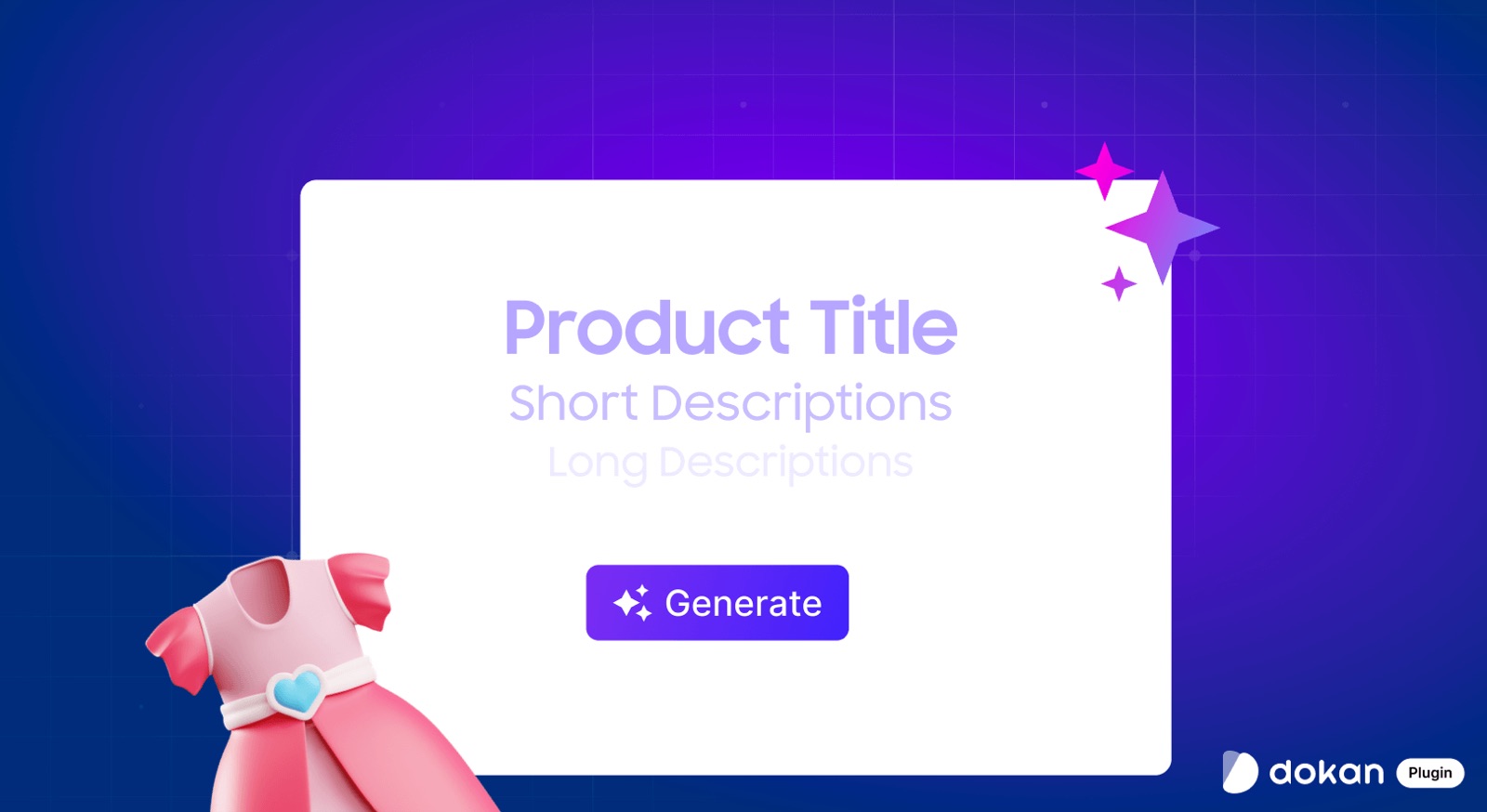 AI product titles and descriptions, the headline feature of Dokan 4.0. Source: Dokan blog, Dokan 4.0 updates
Impact
These are public numbers for Dokan Lite on WordPress.org and the official changelogs, measured during my time on the product.
- 52 releases in 2025 (26 Dokan Lite, 26 Dokan Pro), roughly one of each every two weeks across the year.
- 78 releases from October 2024 to February 2026 (43 Lite, 35 Pro).
- 30+ new features shipped in 2025.
- 531,000+ downloads on WordPress.org in 2025 (531,295, including updates).
- 50,000+ active installs on WordPress.org, held from October 2024 through at least October 2025.
- 4.6/5 rating held while the number of ratings grew from 713 (October 2024) to 763 (March 2026), through two major interface rebuilds.
- Merchants in 52+ countries during my time on the product.
Stack
- WordPress plugin in PHP (7.4+), built on WooCommerce
- React interfaces using WordPress packages (
@wordpress/element,components,data,dataviews), with TypeScript - Tailwind CSS for the new UI component set; legacy Vue 2 screens being phased out
- Shared in-house React UI libraries (Dokan UI, weDevs Plugin UI)
- Dokan REST API powering the React dashboards
- WooCommerce Analytics for vendor and admin reporting
- OpenAI and Google Gemini for text generation; Gemini 2.5 Flash Image and BRIA for image enhancement
- Payment gateways including Stripe Express, Paystack and Razorpay
- PostHog for product analytics
- Open source on GitHub (getdokan/dokan), released through WordPress.org
How I shaped it
- Set the roadmap around one bet. I owned product strategy and the roadmap for Dokan and the wider Dokan plugin portfolio. Generative AI and a React rebuild became the 2025 story, and Dokan 4.0 shipped as the first AI powered multivendor marketplace solution.
- Gave vendors real data. I added a data-oriented reporting solution for marketplace vendors, synced with WooCommerce Analytics, so vendors could see their own sales without asking the admin. That turned reporting from a support request into self-service.
- Made performance visible. I built a month over month and quarter over quarter product health framework covering velocity, quality, engagement, KPIs and OKRs. Leadership used it to prioritise across the portfolio.
- Used behaviour data to decide. I owned product tracking in PostHog: drop-off analysis, feature adoption and inputs to prioritisation, so roadmap calls were backed by what users actually did.
- Wrote the specs. I owned PRDs and worked with a cross-functional team of 20+ across engineering, design and associate PMs, with product operations SOPs that kept handoffs clear.
- Planned beyond the plugin. I owned feature roadmaps for the Dokan vendor app, the Delivery Driver app and helper plugins, so the marketplace experience stayed consistent across web and mobile.
- Connected product to the market. I worked with marketing, support, business development and pre-sales on integrations, compatibility and tailored demos that helped close deals.
 The vendor dashboard migration to React, part of Dokan 4.0. Source: Dokan blog, Dokan 4.0 updates
How it moved on
- Nov 2024: WooCommerce Analytics compatibility; Printful print-on-demand integration
- Dec 2024: commission overhaul and rebrand (3.14.0)
- May 2025: Dokan 4.0 with AI text generation and a React vendor dashboard
- Sep 2025: AI image enhancer; React admin dashboard (4.1.0)
- Oct to Dec 2025: Paystack, vendor support tickets, auction anti-sniping, full-width dashboards (4.2.0), Razorpay subscriptions
- Feb 2026: Cloudflare Turnstile (4.3.0) and Stripe Express block checkout; I moved on from Dokan
- 2026: the Dokan Lite line reached version 5.x, and a new branded vendor mobile app was announced in August
Links
- Dokan: official product site for the WordPress plugin
- Pricing: Dokan Pro plans and modules
- Documentation: setup guides for admins and vendors
- Changelog: dated release notes for Dokan Lite and Pro
- Dokan Lite on WordPress.org: the free plugin, ratings and screenshots
- getdokan/dokan on GitHub: open source code and full Lite changelog
- Dokan 4.0 launch post: AI writing, React vendor dashboard and everything else in 4.0 (May 2025)
- Dokan year in review 2025: the team’s own summary of 2025
- Dokan plugins and apps: the wider plugin portfolio I managed alongside Dokan