FlyCommerce
No-code, cloud-hosted SaaS commerce platform for single stores and multivendor marketplaces. Formerly Dokan Cloud.
What it is
FlyCommerce is a no-code, cloud-hosted commerce platform from weDevs. A merchant can launch a single online store, a full multivendor marketplace, or add a marketplace layer to a store they already run. There is no WordPress to maintain, no server to patch, and no stack of plugins to keep in sync. The platform handles hosting, storefront design, checkout, payments, shipping, tax, returns and vendor payouts in one place.
It serves two kinds of customer: shop owners who want a branded store without a technical setup, and marketplace operators who need vendor onboarding, commissions, payouts and vendor dashboards out of the box. The second group is harder to serve, and it is where the product has its roots: it was called Dokan Cloud until April 2026, the hosted sibling of the Dokan multivendor plugin for WordPress.
 A storefront built on FlyCommerce, desktop and mobile. Source: FlyCommerce
The problem it solves: running a marketplace on a self-hosted stack means owning hosting, updates, plugin conflicts and scaling yourself. weDevs built the cloud version to remove exactly that. FlyCommerce keeps the marketplace depth and takes the operations away.
Industry
Hosted commerce is a crowded market. Shopify, Wix and BigCommerce lead for single stores, and they are very good at it. Marketplaces are a different problem. Most hosted builders assume one seller, so a marketplace operator either stitches apps together or moves to specialist marketplace software. Self-hosted WooCommerce with a multivendor plugin is flexible but hands the merchant every operational problem.
FlyCommerce sits in that gap: multivendor depth delivered as a managed SaaS product, with a single-store line alongside it. The second shift in the market is AI. Merchants expect help building a store, and shoppers are starting to buy through AI assistants instead of search and storefronts. That is where FlyCommerce is now heading.
What happened
I started working on FlyCommerce in April 2026, the month Dokan Cloud became FlyCommerce. Everything before that is product history built by the team before me, and I describe it here as context, not as my work.
Before I joined. Dokan Cloud launched in March 2024 as a hosted marketplace builder. A single-store version (Shop) followed in November 2024, and 2025 added WooCommerce migration, a theme store and regional payments. The timeline below has the detail.
The rebrand (April 2026). Dokan Cloud became FlyCommerce. The point was to give the SaaS product its own identity, separate from the Dokan WordPress plugin, and to stop it reading as “the cloud version” of something else. The announcement named the direction: premium user experience, native AI, deeper eCommerce-specific features and better support. Stores, data and settings carried over unchanged, so customers did not have to migrate anything. The Dokan plugin was not affected.
 The rebrand announcement, April 2026. Source: Dokan blog
In the product, the change was a banner and a new logo. A rename should cost the merchant nothing.
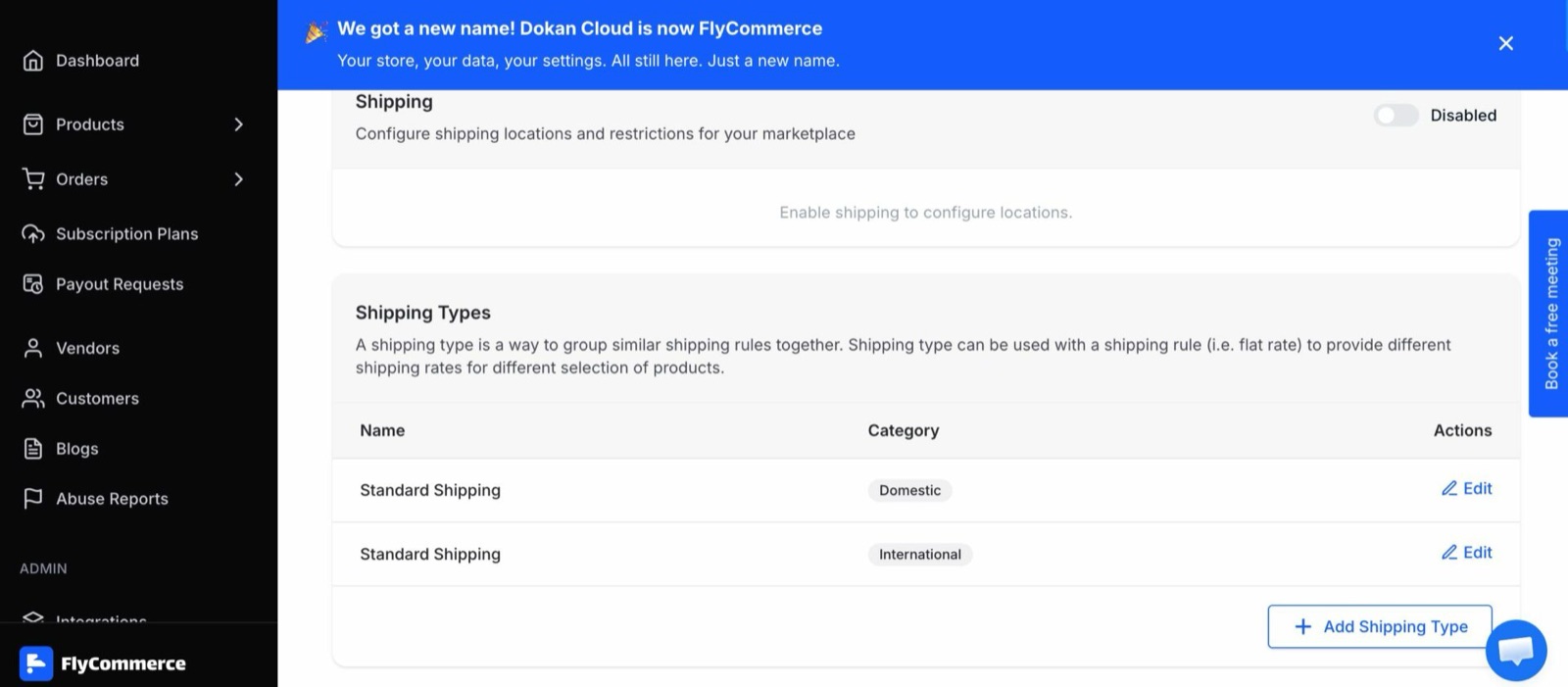 The admin dashboard after the rename, with the in-app notice to merchants. Source: Dokan blog
Closing the gaps marketplaces feel first (June 2026). The first major release after the rebrand went after the work that hurts marketplace operators most: returns and refunds. Customers request returns from their order page, admins and vendors work a shared queue, and refunds need approval before money moves. Operators choose who pays return shipping and who absorbs payment gateway fees. The release also added automated tax at checkout.
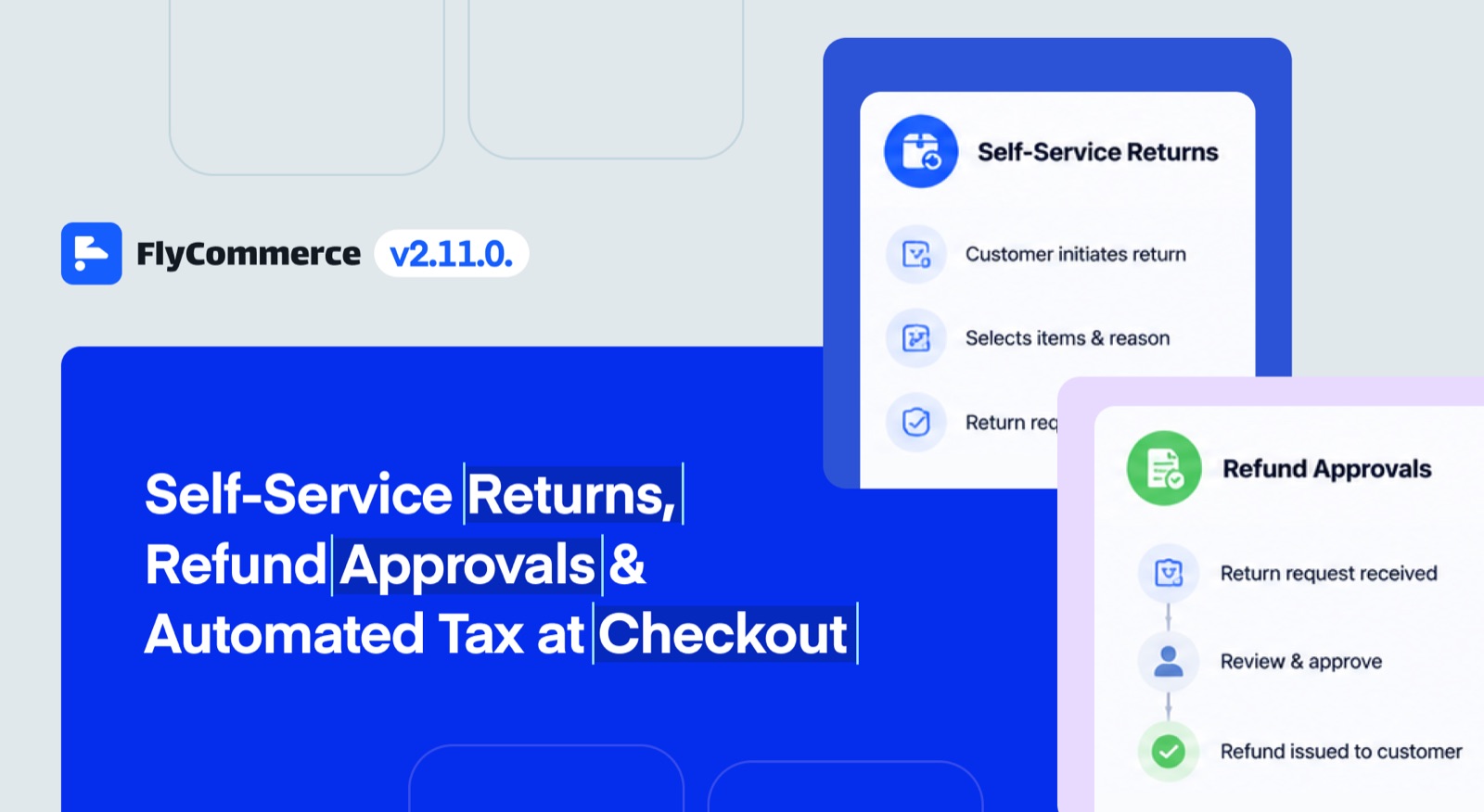 Release banner for returns, refund approvals and automated tax. Source: FlyCommerce changelog
AI from roadmap to product (August 2026). The rebrand named native AI as a direction. About four months later it shipped. A new merchant can describe their business and get theme suggestions, a live preview and a demo catalogue instead of a blank store. FlyBuddy, an AI page builder in beta, generates page structure and content blocks from a plain-language prompt, and everything it creates stays editable. The same release opened the platform to developers with a Public API, a Developer Portal and an App Store, and added pre-orders, invoicing and abandoned cart recovery.
Running the business, not just the store (September 2026). Two releases focused on how vendors, teams and shoppers communicate. Vendors got support tickets with an admin queue and audit trail, team permissions became more granular, and merchants can join an affiliate programme powered by Partnero. WhatsApp Business arrived for order and delivery updates, with login-free order links and consent handling. Per-store llms.txt, AI crawler controls and an agentic commerce product feed prepared storefronts for AI shoppers.
Agentic commerce and the money layer (October 2026). Agentic Commerce lets supported AI assistants discover products and help shoppers through the purchase, while the shopper still approves every payment. It works with Google Gemini and AI Mode, ChatGPT and Claude, with a dashboard that includes readiness checks, activity logs and a kill switch. For marketplace operators, Ledgerbook brings vendor earnings, commissions, refunds, cash-on-delivery debt and payouts into one financial workflow, and a payout is marked Paid only when the money has actually moved.
Impact
- A rebrand that cost customers nothing: stores, data and configurations carried over as they were (April 2026).
- AI shipped, not just promised: native AI was a stated direction at the rebrand in April 2026 and became a shipped AI store setup and page builder in August 2026, then agentic commerce in October 2026.
- Marketplace basics closed: returns, refund approvals, automated tax and a single ledger for vendor money moved from gaps to built-in features (June to October 2026).
- A steady release rhythm through the rebrand: major releases in June, August, September and October 2026.
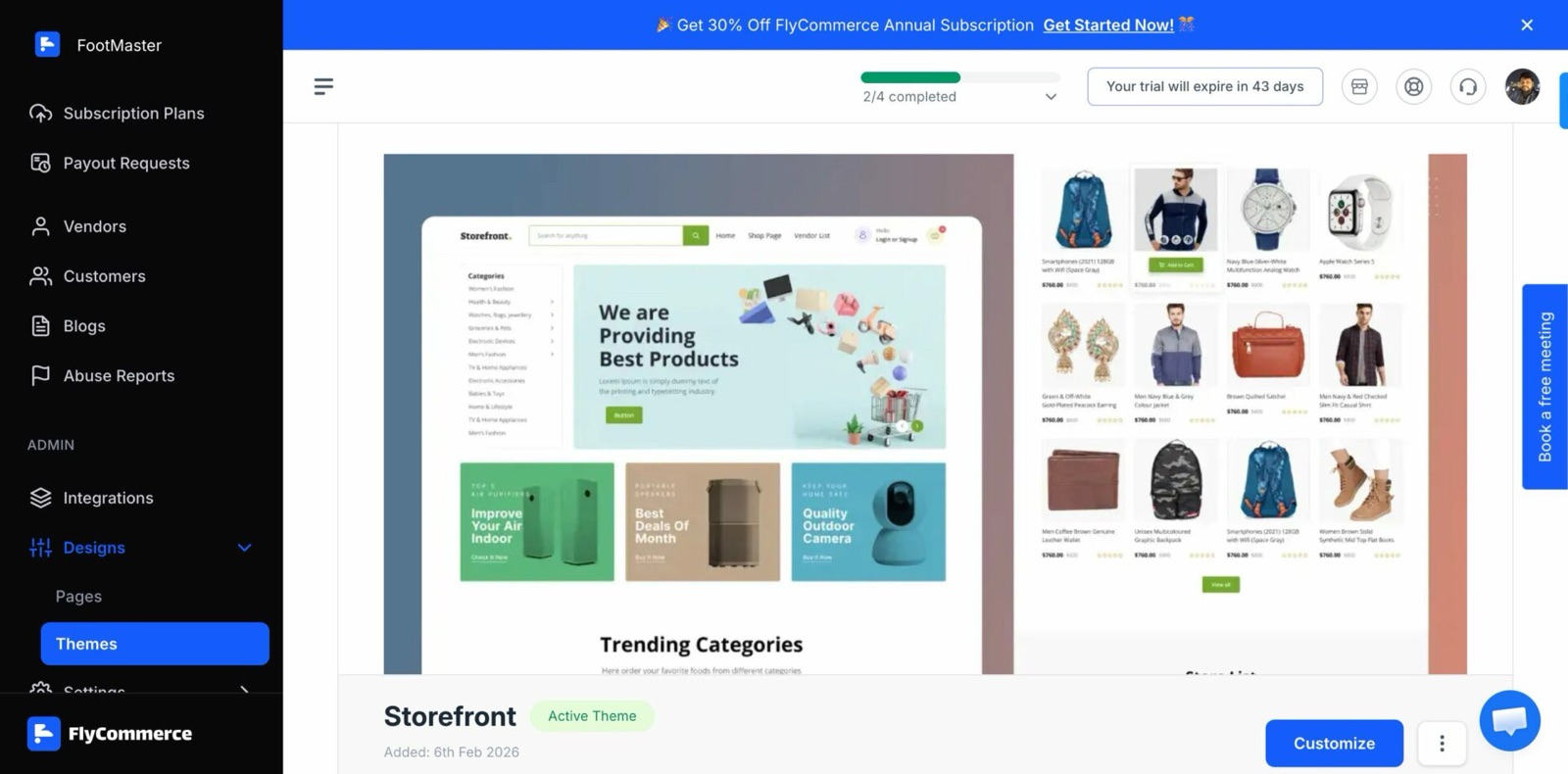 Theme management in the merchant dashboard. Source: Dokan blog
Stack
Only what FlyCommerce documents publicly.
- Platform: fully managed, cloud-hosted SaaS with custom domains, a drag-and-drop page builder and AI store setup
- Payments: Stripe, PayPal, MangoPay, Razorpay, Tap, Paystack, Payfast, bKash, cash on delivery
- Tax and shipping: Avalara AvaTax (certified integration), Pathao courier
- Marketing and messaging: Mailchimp, Twilio SMS, WhatsApp Business, live chat
- Analytics and tracking: Google Analytics 4, Google Tag Manager, Meta Pixel
- AI channels: Google Gemini and AI Mode (UCP), store MCP server for Claude and ChatGPT, ChatGPT Shopping feed
- Extensibility: Public API, Developer Portal, App Store, webhooks, WooCommerce migrator, affiliate programme via Partnero
How I shaped it
I have owned FlyCommerce as product manager since April 2026, alongside FlyWP.
- Product direction: own the roadmap across the single-store and marketplace lines, and decide what ships next based on customer feedback, support signals, competitive gaps and business goals.
- Marketplace depth first: prioritise the operator problems that block growth, such as returns, refunds, tax and vendor money, before adding surface features.
- AI and agentic commerce: bring AI into the roadmap two ways: helping merchants build stores faster, and making stores buyable through AI assistants, with the shopper approving payment.
- Specs and issues: turn research, support feedback and business goals into clear PRDs and structured issues the team builds from, which keeps releases focused.
- Pricing and packaging: shape the plans and what each includes, so a merchant can start small and grow without switching platforms.
- Product operations: set the release rhythm, a decision log and a shared product workspace that people and AI agents both work from, so decisions are visible and work does not stall.
How it moved on
Before April 2026 is product history; from April 2026 is my period.
- Mar 2024: Dokan Cloud launches as a hosted multivendor marketplace builder
- Oct 2024: bulk product editing, collections and PayPal subscriptions for vendors
- Nov 2024: Shop beta brings the single-store version
- Feb 2025: OTP mobile login, shipping revamp and yearly billing
- May 2025: WooCommerce migration, custom email domains, bKash and wishlists
- Jun to Sep 2025: Theme Store, webhooks, private digital files and a customisable vendor sign-up page
- Jan to Mar 2026: checkout improvements, flat-rate shipping, multi-currency and blogging
- Apr 2026: rebranded to FlyCommerce
- Jun 2026: self-service returns, refund approvals and automated tax at checkout
- Aug 2026: AI store setup, FlyBuddy page builder, Public API, App Store and pre-orders
- Sep 2026: vendor support tickets, affiliate programme, team permissions, WhatsApp Business and AI crawler controls
- Oct 2026: Agentic Commerce and Ledgerbook for marketplace money management
Links
- FlyCommerce: official website
- Pricing: Shop and Marketplace plans
- Documentation: merchant help docs
- Developer docs: Public API and App Platform
- Changelog: every release, from Dokan Cloud to today
- Introducing FlyCommerce: the April 2026 rebrand announcement
- AI Store and Page Builder release: AI setup, FlyBuddy and the Public API
- Agentic Commerce release: AI assistant shopping and Ledgerbook
- Introducing Dokan Cloud: the original March 2024 launch post
- Dokan Cloud on Product Hunt: listing under the old name