Virtunus To-Do
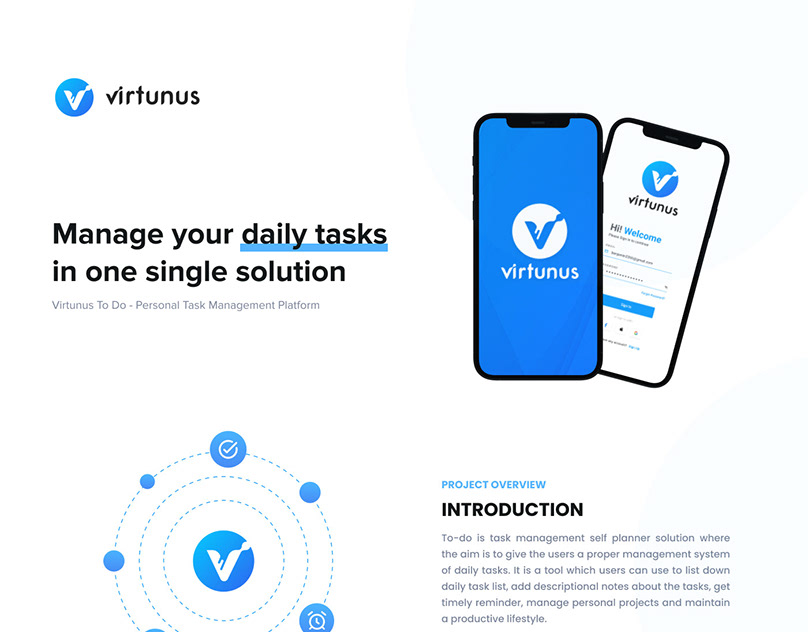
A personal task management and self-planner app from Virtunus, a US-registered company, built to manage daily tasks in one single solution.
What it is
Virtunus To-Do, which the team also called the Personal Resource Planner, is a task manager and self-planner for individuals. It was the first product of Virtunus Inc., a startup registered in Middletown, Delaware, with its product team in Dhaka. The idea was simple: one place to list the day’s tasks, add notes to them, get reminded at the right time, run personal projects and keep a steady routine.
The landing page put the promise in one line: “Let nothing slip through the cracks.” Underneath it: “Have your very own personal assistant with you. Anywhere! Anytime!” The product was free to start and ran as a web app at todo.virtunus.com, with mobile apps planned alongside it.
The problem it went after was not a lack of to-do apps. It was the way real people actually managed their day. In our research, people kept tasks in spreadsheets, stuck notes on their desk to remember things, and kept separate sheets with different people to track shared work. Tasks got skipped because nothing reminded them at the right moment, and work that depended on other people had no shared home. To-Do was designed to replace that patchwork with one organised list, timely alerts and simple collaboration.
Industry
Personal productivity is a crowded, global category. When Virtunus launched, the obvious reference points were Todoist and Any.do, which a 2021 Future Startup feature named as the apps Virtunus was positioned against. Both are polished, cross-platform and well funded. A new entrant cannot win on “another checklist”. It has to win on a sharper idea of how a person plans.
Our angle was structure around the kind of task. Most tools treat a meeting, a study session and a trip as the same row of text. To-Do introduced Activity Types: templates for common activities, so a “Meeting” or a “Travel” task carries the right fields and steps from the start. The landing page framed it as “the way things are supposed to be done”, from organising a meeting to getting a good night’s sleep.
What happened
I joined Virtunus as a product management intern in November 2020 and became product manager in February 2021. To-Do was the company’s core product for my whole time there, until December 2022.
Late 2020: research and first mock-ups. As an intern, I studied the task management tools on the market and drew the first UI mock-ups of the Personal Resource Planner. This was where I learned the craft on the job: roadmaps, development lifecycles, product marketing and business scoping.
Early 2021: the web app goes live. The web app was publicly reachable at todo.virtunus.com by February 2021, with Inbox, Today, Upcoming and Projects views. In April 2021 I published the landing page design that framed the product in three parts: Activity Types, a priority-focused Task Planner (“Prioritise what really matters”) and a Task Manager (“Turn plans into reality”), plus sync across platforms and devices and integrations with everyday tools.
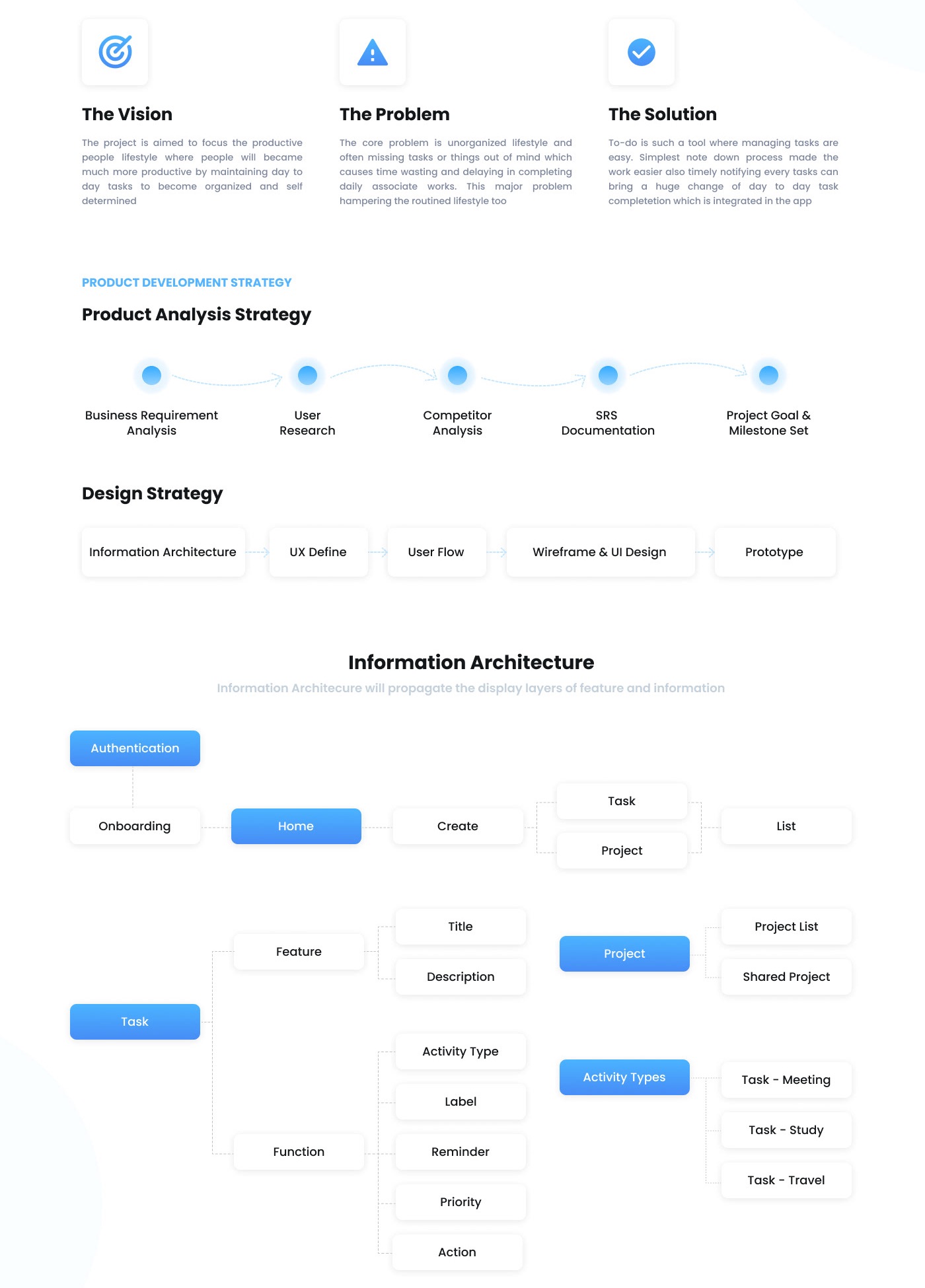 Vision, problem and solution, the product analysis and design strategy, and the information architecture. Source: Jamil Mahmud on Behance
2021: research, definition and design. We followed a clear product analysis path: business requirement analysis, user research, competitor analysis, an SRS, then project goals and milestones. Design followed its own path: information architecture, UX definition, user flow, wireframes and UI, then a prototype.
User research ran as questionnaire sessions with the product owner and with different groups of users. It surfaced seven user groups the product had to serve: office people, students, health experts, athletes, travellers, teachers and project holders. An affinity map then sorted what we heard into common problems, expectations and features.
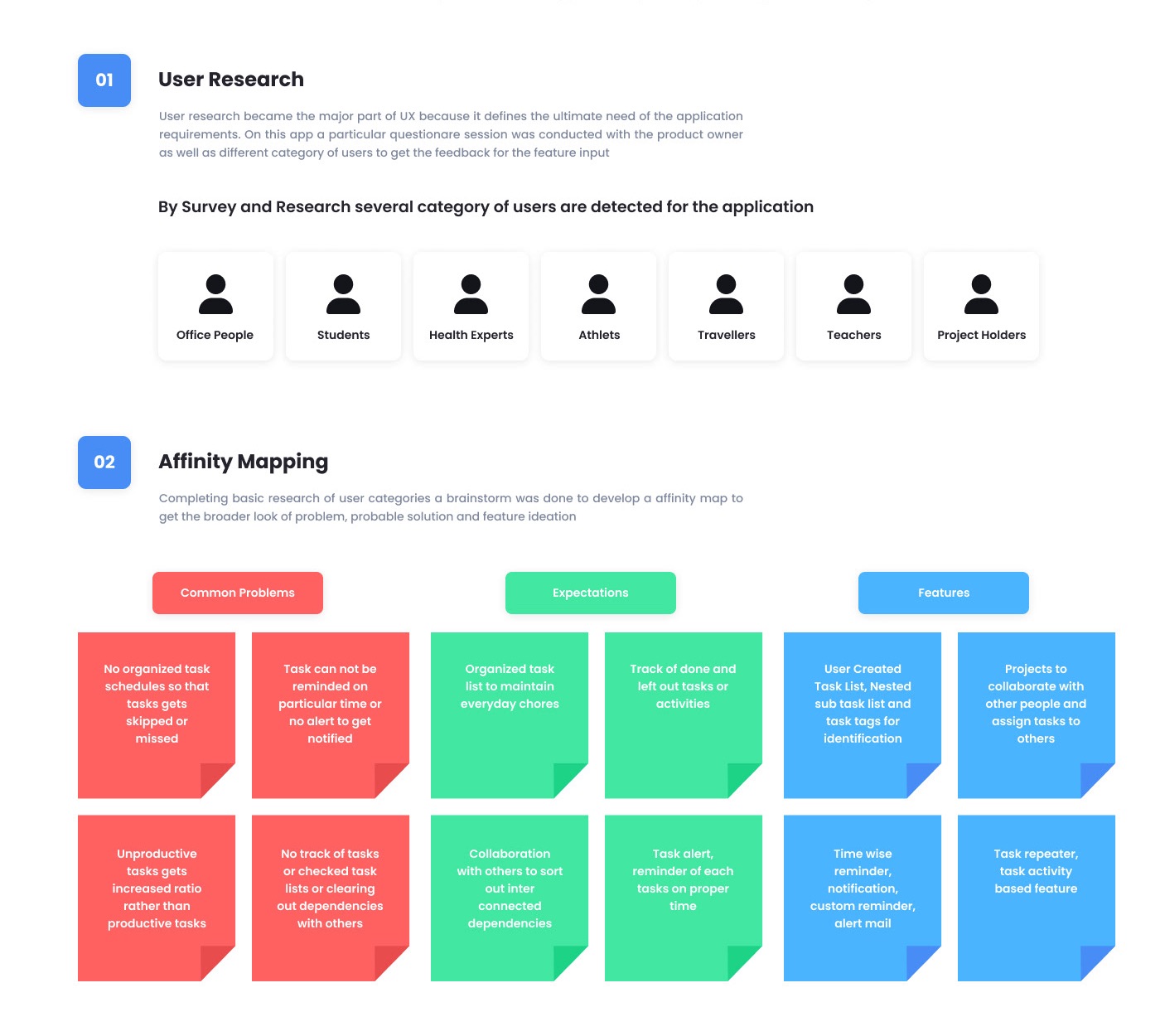 Seven user groups and the affinity map that turned research into features. Source: Jamil Mahmud on Behance
Late 2021: in beta, next to Tips. By November 2021 the productivity app was still in beta, while the company launched its second product, Tips by Virtunus, which turned expert advice into to-do lists. The two shared one idea: success comes from small tasks done on time.
June 2022: the case study. I documented the full UX work in a public case study on Behance, from vision to high-fidelity screens.
Impact
There is no public usage data for To-Do, so I do not quote any numbers here. What I can show is the work and what it made possible:
- A product that went from intern research and mock-ups (late 2020) to a live web app (February 2021)
- A complete feature model, documented in a PRD and SRS, that engineering could build from
- A research base of seven user groups and a mapped set of problems that also informed Tips by Virtunus, the company’s second product
- A public case study (June 2022) that shows the end-to-end process
Stack
- Web app: single-page JavaScript app at todo.virtunus.com (its build files follow the Create React App pattern)
- Marketing site: WordPress (virtunus.com, 2021)
- Platforms: web, with mobile apps planned in parallel
- Design and research: Figma for UX, wireframes, UI and prototypes
- Planned integrations shown in the design: Zoom, Gmail, Google Meet, Skyscanner
How I shaped it
- Turned a broad brief into a scoped product. “A personal resource planner” can mean anything. I narrowed it to a clear feature model: Inbox for loose tasks, Today, Upcoming (up to two years ahead), and Projects with up to four levels of sub-projects.
- Built the UX on competitor analysis, not guesswork. I analysed how competing apps handled tasks, reminders and sharing, and used that to decide where To-Do should match the market and where it should be different.
- Gave tasks real structure. Each task could carry a priority, a due date and time, reminders, a repeat rule, a colour, a description, up to five sub-tasks, comments, attachments, emoji and audio notes. Activity Types (meeting, study, travel) gave common tasks a ready-made shape.
- Designed collaboration with clear rules. Users could invite people to a project, share it and assign tasks. I defined the edge cases too: a shared project cannot be deleted, a member can only leave it, and only a solo project can be deleted. Rules like these stop data loss before it happens.
- Defined the business logic with the team. I worked with design, engineering and content marketing to choose features, define the logic behind them and set the go-to-market plan.
- Owned the documents engineering built from. I wrote the feature documentation, the PRD and the SRS, and mapped the user journey from onboarding to settings (time zone, language, date format, weekday and notifications).
- Planned the release. I managed and coordinated the product release plan across design, engineering and content marketing.
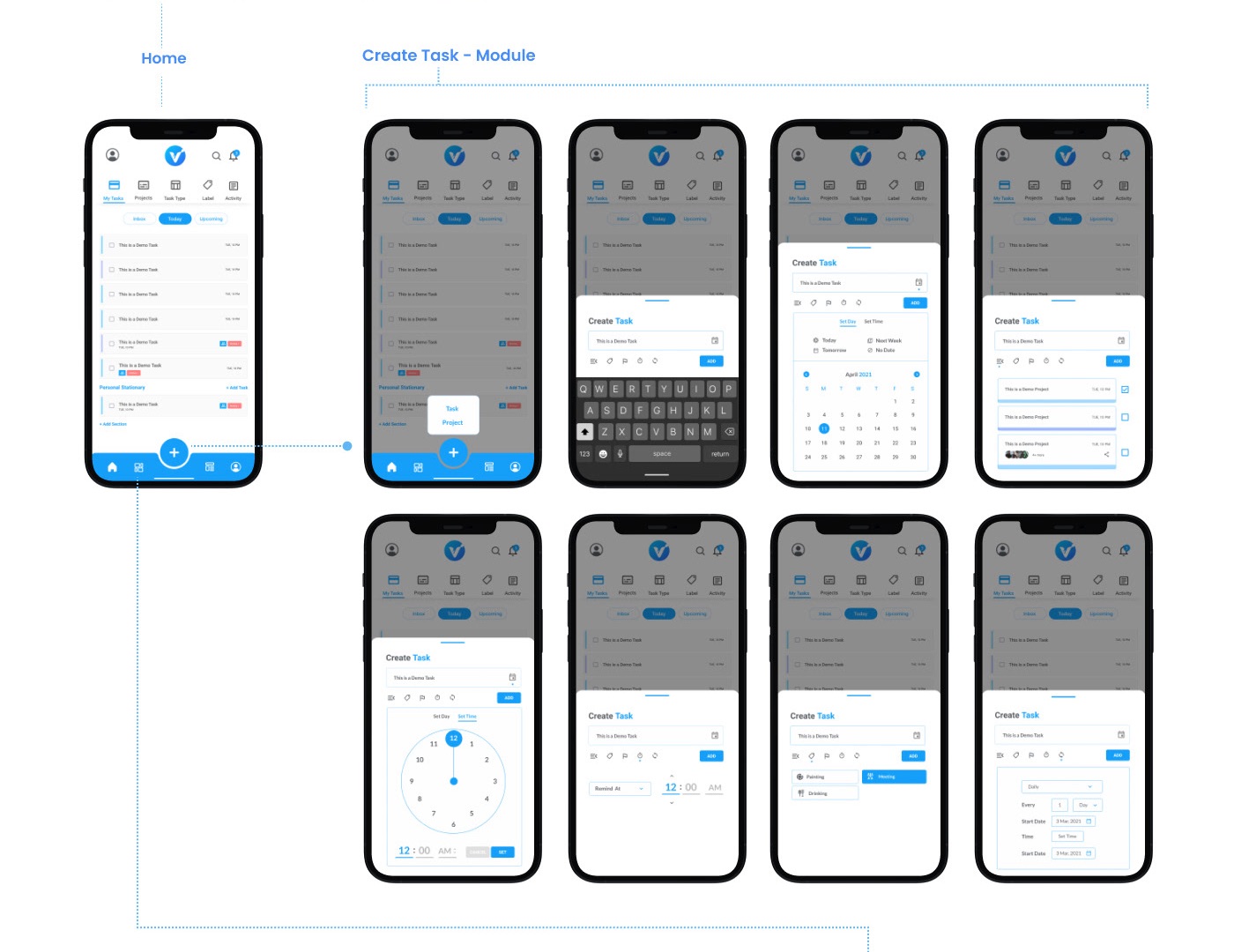 The Create Task module: date, time, reminder, activity type and repeat, plus task details and projects. Source: Jamil Mahmud on Behance
The hardest parts were the ones the case study lists as challenges: finding the right scope, understanding the psychology of productivity, designing person-to-person collaboration inside the app, adapting features across platforms, and doing research that fit the users’ regional context.
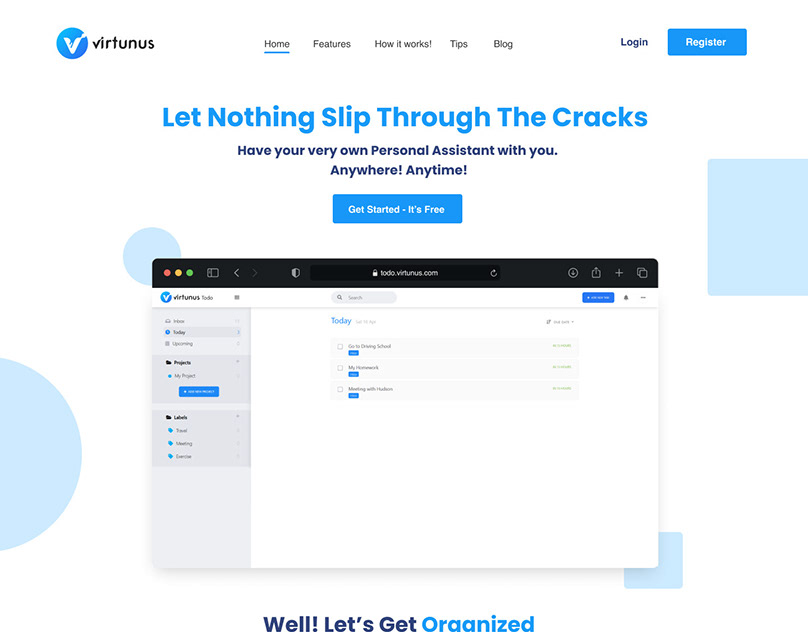 The landing page design: Activity Types, Task Planner, Task Manager and integrations. Source: Jamil Mahmud on Behance
How it moved on
- Nov 2020: I start as product management intern: tool research and first mock-ups
- Feb 2021: I become product manager; the web app is live at todo.virtunus.com
- Apr 2021: Landing page design published: Activity Types, Task Planner, Task Manager, integrations
- May 2021: virtunus.com lists Features, Task Type, Task Planner and Integrations pages
- Nov 2021: The productivity app is in beta; Tips by Virtunus launches beside it
- Jun 2022: UX case study published on Behance
- Dec 2022: I leave Virtunus; the web app is still reachable that month
- 2026: virtunus.com no longer loads (checked October 2026)
Links
- Todo App, Virtunus: UX case study: my full case study (Behance, June 2022)
- Virtunus landing page design: the product landing page (Behance, April 2021)
- todo.virtunus.com, archived: the web app as captured in December 2022
- virtunus.com features page, archived: the company site in May 2021
- Future Startup on Virtunus: November 2021 feature on the company and its apps
- Tips by Virtunus: the company’s second product, built on the same idea