Zolo ERP-POS
Cloud ERP and point of sale for restaurants, built from zero as three connected apps: ZPOS, Zolo Portal and Zolo Admin.
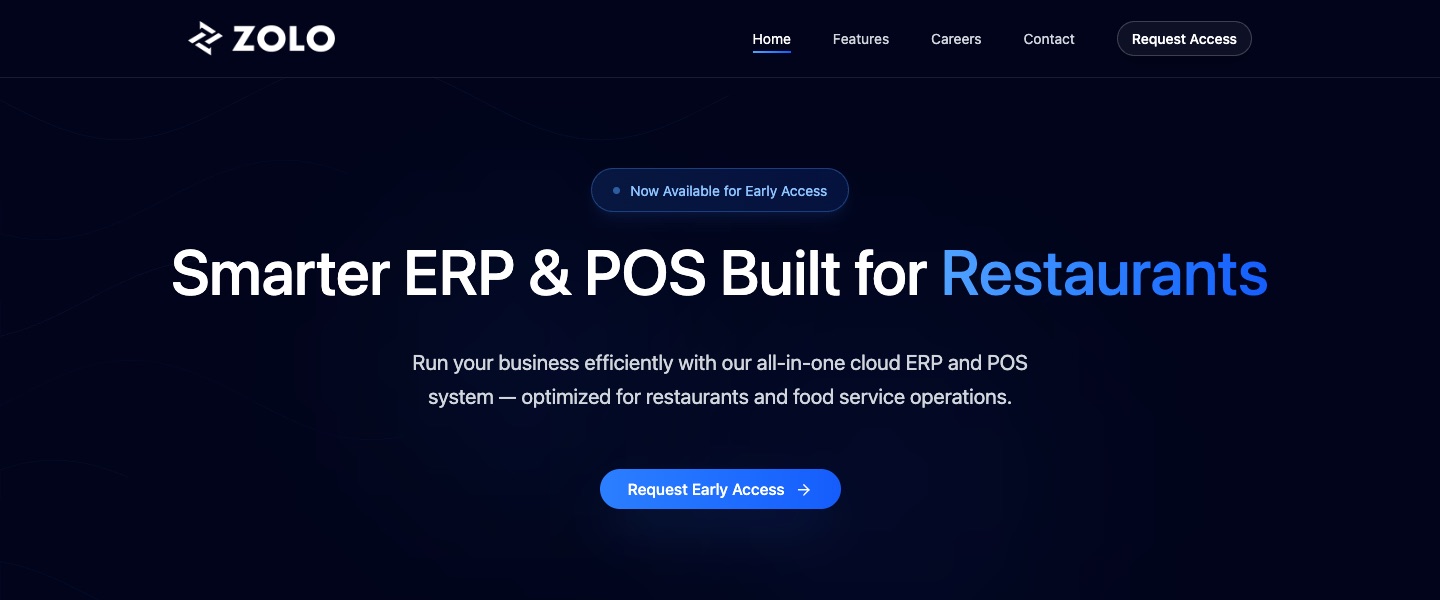 Zolo’s public homepage in 2025, offering early access. Source: Zolo Inc.
What it is
Zolo is a cloud ERP and point-of-sale system for restaurants, from Zolo Inc., a startup in Dhaka. The company’s own line is simple: “Smarter ERP & POS Built for Restaurants.” Its stated mission is to bring smart, accessible business tools to the businesses that need them most, and it says plainly where it begins: “We start with restaurants.”
A restaurant owner usually runs the counter, the kitchen, the stock room and the books on separate tools, or on paper. Orders get lost between counter and kitchen. Stock runs out without warning. Daily sales never quite match the ledger. When there is a second branch, the owner loses sight of it the moment they leave. Zolo puts all of this in one place: take the order, send it to the kitchen, take the payment, update stock, and post it to the accounts.
The product is three connected apps:
- ZPOS, the point of sale used at the counter by cashiers and floor staff
- Zolo Portal, the web portal where the business owner runs menus, stock, staff and reports
- Zolo Admin, the operator console that ties the platform together
The three share one data model. A sale rung up on ZPOS has to show up in the owner’s reports on Zolo Portal, reduce stock, and land in the account ledger, while Zolo Admin, on the operator side, keeps the platform and its restaurants running.
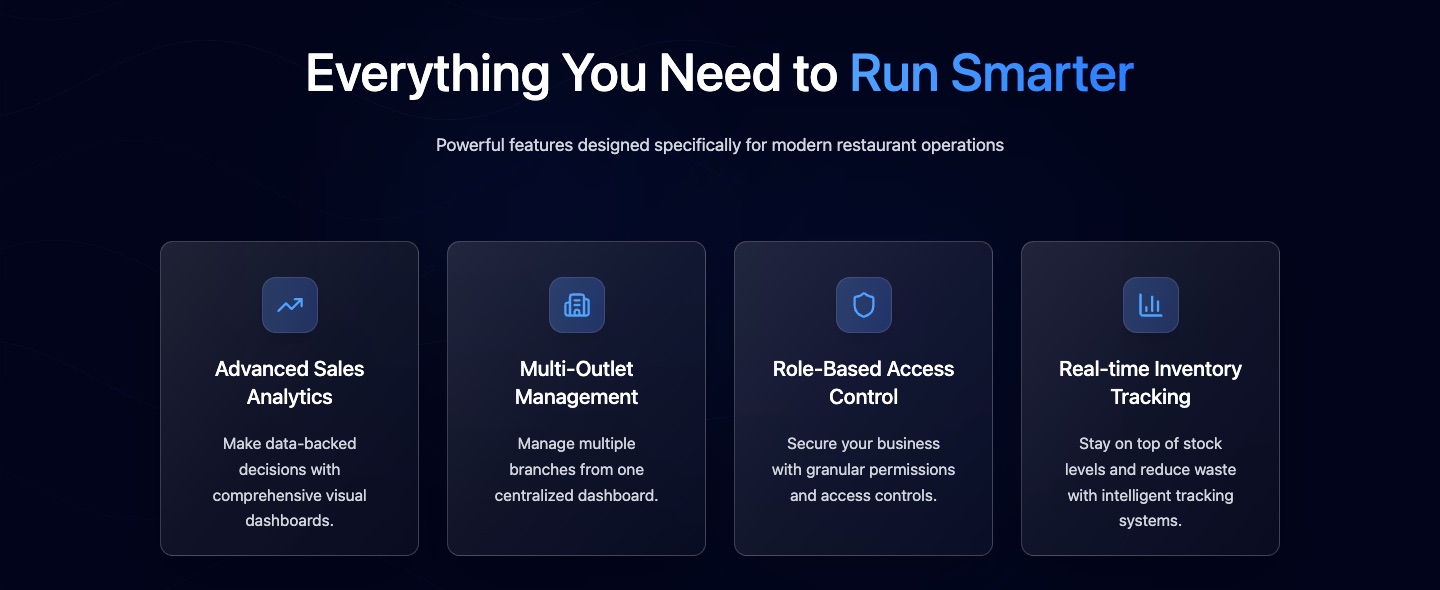 The four headline features on Zolo’s site. Source: Zolo Inc.
The public site lists the core capabilities:
- Advanced sales analytics: visual dashboards for data-backed decisions
- Multi-outlet management: several branches from one central dashboard
- Role-based access control: granular permissions for each member of staff
- Real-time inventory tracking: stock levels kept current to reduce waste
- Kitchen management, point of sale, business intelligence and digital ordering as the four product pillars
Industry
Restaurant POS has turned into a full operating system for restaurants. Payments, menus, kitchen screens, inventory, staff and reporting now sit in one product. In the US, Toast is the clear example: about 134,000 restaurant locations on its platform by 31 December 2024, up 26% in a year (Toast FY2024 10-K). Square and Lightspeed compete for the same owners. The lesson from that market is that the winner is rarely the best till. It is the product that becomes the restaurant’s system of record.
Bangladesh is a very different market. The Bangladesh Bureau of Statistics counted 436,274 hotels, restaurants and tea stalls in 2021. Of those, 67,991 were fast food shops and 19,637 were restaurants and mobile food shops. Most are small, independent and run on cash and paper, with owners who are hands-on and short of time. Local cloud POS tools already compete for them, mostly on price and on the till itself.
Zolo’s bet was different: one affordable system that links the counter, the kitchen, the stock and the accounts, built for how restaurants in this market actually run, and ready for owners who grow from one outlet to several.
What happened
I joined Zolo Inc. in March 2024, at the start of its startup initiative. There was an idea and a team, but no product process, no defined requirements, and no designs. The first job was to give the team a way to build, and the second was to decide what to build.
- Setting up how we build. With engineering, I defined the product development process from scratch: discovery, requirements, design, development and QA as one flow. In a small team, that flow was what let three apps move forward in parallel.
- Learning the market. I ran stakeholder discovery, competitive analysis of existing ERP and POS tools, and live, on-the-spot interviews with people using similar apps. That research defined the core ERP requirements and kept the first version close to daily restaurant work.
- Designing three apps at once. I wireframed the full SaaS application and its connected apps, then took all three to high-fidelity wireframes in 3.5 months.
- Fixing the hard flow. The riskiest part was where the apps met: one order had to move cleanly through order processing, subscription management and the account ledger. That cross-system flow was failing. I traced it end to end and resolved it, so a sale and its accounting stayed in step.
- Testing the idea. I validated the product idea with a data-centric approach to product-market fit, so the team had evidence, not just conviction.
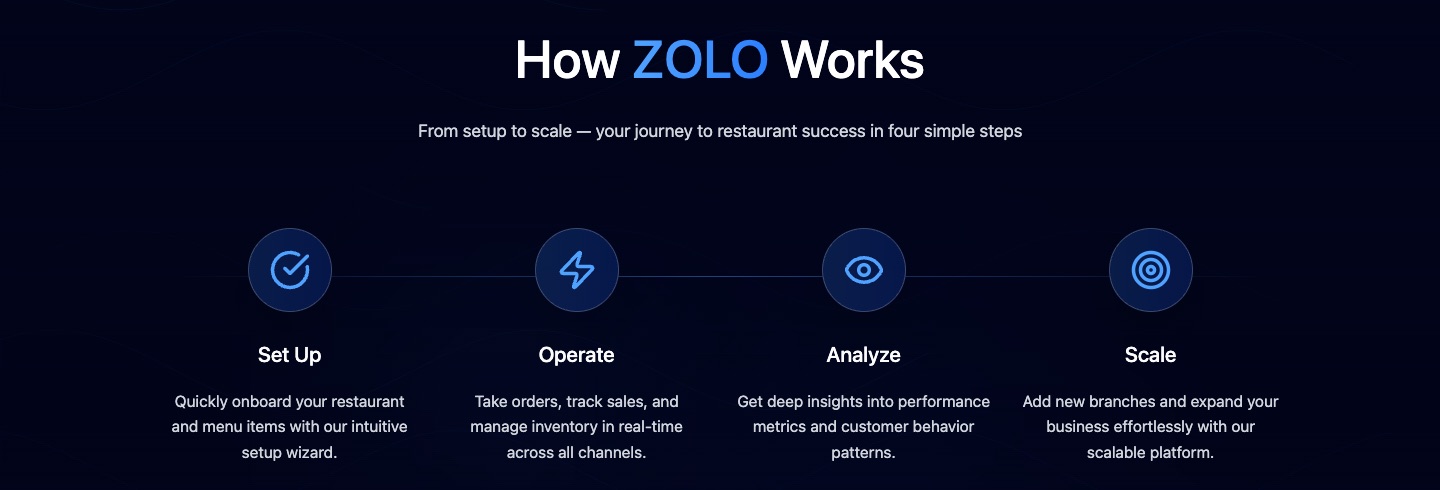 The four-step journey on Zolo’s site: set up, operate, analyse, scale. Source: Zolo Inc.
The journey the product promises today follows the same shape as that early work. Set up: onboard the restaurant and its menu with a setup wizard. Operate: take orders, track sales and manage inventory in real time across channels. Analyse: read performance and customer behaviour. Scale: add new branches on the same platform.
I left in October 2024 to join weDevs.
Impact
- 3 connected apps (ZPOS, Zolo Portal, Zolo Admin) taken to high-fidelity wireframes in 3.5 months (2024)
- A product development process built from zero, covering discovery, requirements and delivery (Mar to Oct 2024)
- Core ERP requirements defined from stakeholder discovery, competitive analysis and live user interviews (2024)
- A critical cross-system flow (order processing, subscription management, account ledger) resolved (2024)
No usage or revenue numbers are public for this product, so I do not quote any.
Stack
- Figma (wireframes and high-fidelity designs)
- Cloud SaaS: web-based ERP back office plus POS app, per Zolo’s public site
- Role-based access control and multi-outlet data model, per Zolo’s public site
How I shaped it
- Gave the team a way to ship. A clear path from discovery to requirements to delivery meant a small startup team could build three apps in parallel without losing track.
- Grounded the scope in real restaurants. Interviews and competitive analysis decided what went into the core ERP, so the first version focused on what owners and staff actually do every day.
- Designed the system, not just screens. I wireframed the three apps as one connected product, so the counter, the back office and the operator console share the same data and rules.
- Removed the biggest flow risk. Solving the order, subscription and ledger flow kept money and records consistent across the three apps. In a product that owners trust with their takings, that is the part that cannot be wrong.
- Kept the bet honest. Validating product-market fit with data gave the team a clear reason for each thing it built.
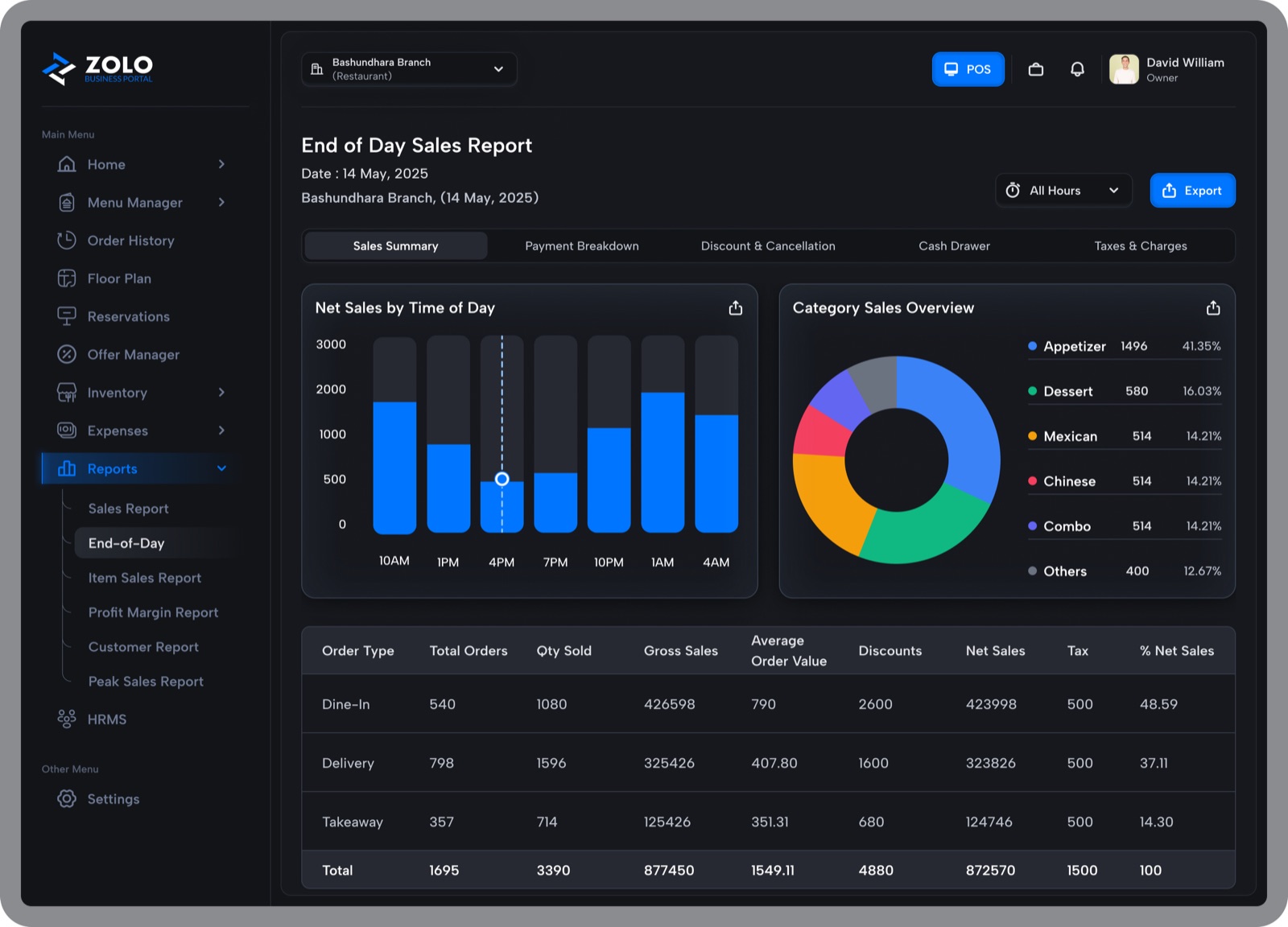 Zolo Business Portal: end-of-day sales report by time of day, category and order type (sample data, May 2025). Source: Zolo Inc.
The Business Portal screen Zolo shows publicly in 2025 gives a sense of where the owner side went after my time. Its menu covers a home dashboard, menu manager, order history, floor plan, reservations, offer manager, inventory, expenses, reports and HRMS. Reports include sales, end of day, item sales, profit margin, customers and peak sales, and owners switch between branches from the top bar, with a direct jump to the POS.
How it moved on
- 2024: Zolo Inc. founded in Dhaka (LinkedIn company page)
- Mar 2024: I join as Product Manager; process, discovery and requirements start
- By mid 2024: high-fidelity wireframes for ZPOS, Zolo Portal and Zolo Admin done in 3.5 months
- Oct 2024: I move on to weDevs
- 2025: Zolo’s public site is live, positioning the product as “Smarter ERP & POS Built for Restaurants”, with early access by request
- May 2025: the Business Portal shown on the site carries branch switching, floor plan, reservations, offers, expenses, HRMS and a full set of sales reports
- Oct 2025: site last updated; it lists multi-outlet management, inventory, analytics and role-based access, and still offers access by request
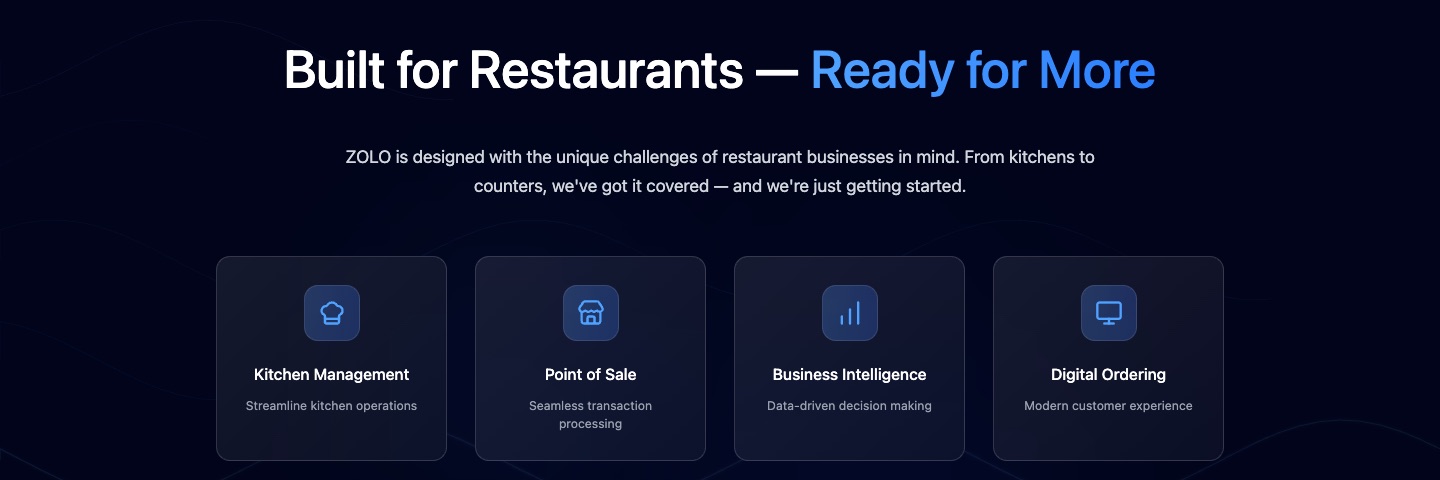 “Built for Restaurants”: Zolo’s four product pillars. Source: Zolo Inc.
Links
- Zolo Inc.: official site, features and early access requests
- Zolo Inc. on LinkedIn: company page, Dhaka, founded 2024
- Zolo Inc. on Facebook: company page
- Toast FY2024 annual report (10-K): source for the restaurant platform figures above
- BBS Hotel and Restaurant Survey 2021, via Bangladesh Monitor: source for the Bangladesh market figures
- Work history: my role at Zolo Inc., March to October 2024